
Informacje z Euroregionu Bałtyk
BaltWrecktl-ne BaltWreck News English pll_6984b03d1a6c3
From Seafloor to Screen: One Year of Data Coming Together in BALTWRECK
Over the past year, the BALTWRECK project – Preventing massive marine waters chemical pollution from the leaking wrecks and munition/weapon dumps in the South Baltic – has taken an important step forward in turning extensive fieldwork into an accessible and usable knowledge base. A major focus of recent activities has been the systematic collection, compilation, and organization of data related to selected wrecks in the South Baltic Sea.
During dedicated research cruises in August and September 2025, led by scientists from the University of Gdańsk (UG), a wide range of complementary datasets was gathered at sea. These cruises targeted specific wreck sites and applied multiple observation and sampling techniques to capture a detailed picture of conditions around the wrecks. The collected material includes hydroacoustic survey data, such as multibeam echosounder (MBES) and acoustic camera measurements, as well as 4K video footage acquired with remotely operated vehicles (ROVs). In addition, sediment and water samples were taken from the vicinity of the wrecks, adding an essential environmental component to the data.
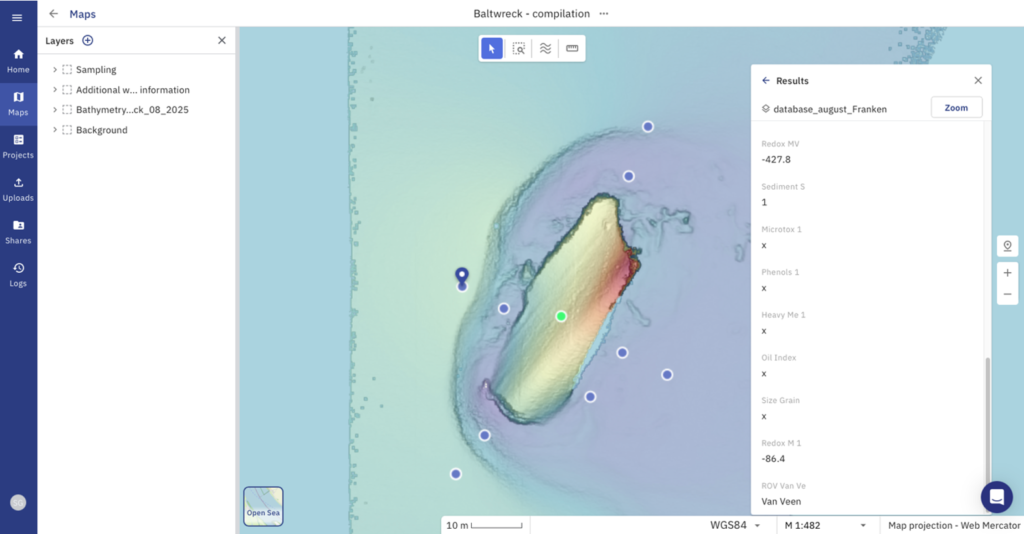
As the volume and diversity of project data have grown, equal attention has been given to how these datasets are managed and made available within the project. north.io’s Ocean Data Platform, TrueOcean, is being used as a central web-based platform for compiling the BALTWRECK-related data. TrueOcean functions as a unified data management and dissemination hub, bringing together the different data types generated during the cruises in a single, coherent environment.
Having these datasets compiled on a shared platform allows project partners to systematically investigate the collected information and to view it in its broader spatial and thematic context. This consolidated overview supports ongoing analysis and provides a solid foundation for planning additional research expeditions and future survey activities. With the data now accessible through a web-based platform, BALTWRECK is well positioned to build on the intensive fieldwork of the past year and to continue its coordinated research efforts in the South Baltic Sea.