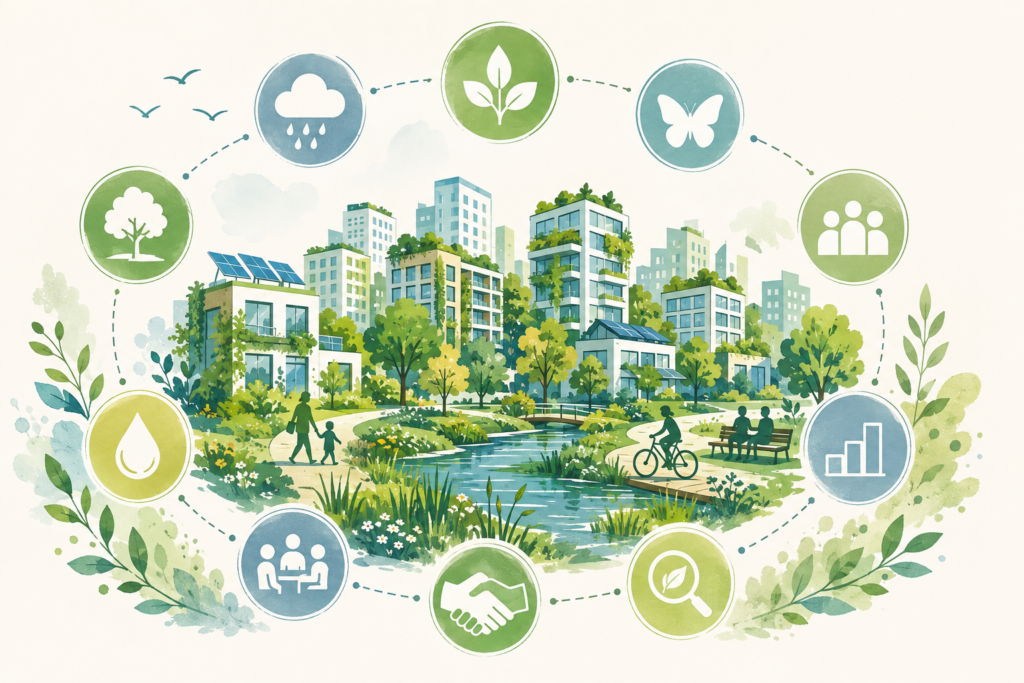
On September 9, 2026, the CONE project partners will meet in Wejherowo for a study visit focused on nature-based solutions, local pilot projects, and the use of the Urban Living Lab method in local government activities.
The CONE project focuses on developing eco-friendly solutions that address local climate challenges. A key element of the project is engaging residents, local governments, experts, the scientific community, and the private sector in the joint design, testing, and evaluation of solutions that can increase the resilience of cities and municipalities to the effects of climate change.
The program includes:
a presentation on Ekofabryka Wejherowo Sp. z o.o. and its activities,
an overview of pilot projects implemented as part of the CONE project,
a discussion on experiences with implementing nature-based solutions,
a meeting of project partners and a discussion of the next stages of collaboration,
an exchange of knowledge on the potential for applying the Living Lab approach in small and medium-sized cities and municipalities.
In the CONE project, a Living Lab is understood as an environment for collaborative work on solutions for the city. The process involves analyzing local needs and barriers, co-designing ideas, testing them, gathering feedback, and assessing the potential for further use and replication in other locations.
The visit to Wejherowo will be an opportunity to see local initiatives in action and discuss how nature-based solutions can support:
adaptation to climate change,
increasing the resilience of local communities,
better use of data in planning,
resident participation in decision-making,
the development of solutions that can also be applied in other municipalities.
The partners’ meeting will also allow us to compare the project’s objectives with local experiences and gather the knowledge needed to further develop, refine, and disseminate the pilot projects.
Date: September 9, 2026 Location: Wejherowo Start of the visit: Ekofabryka
You can read more about the project on the website
Call for Entries for the 6th National Competition for Local Government Units for the Most Energy-Innovative Local Government
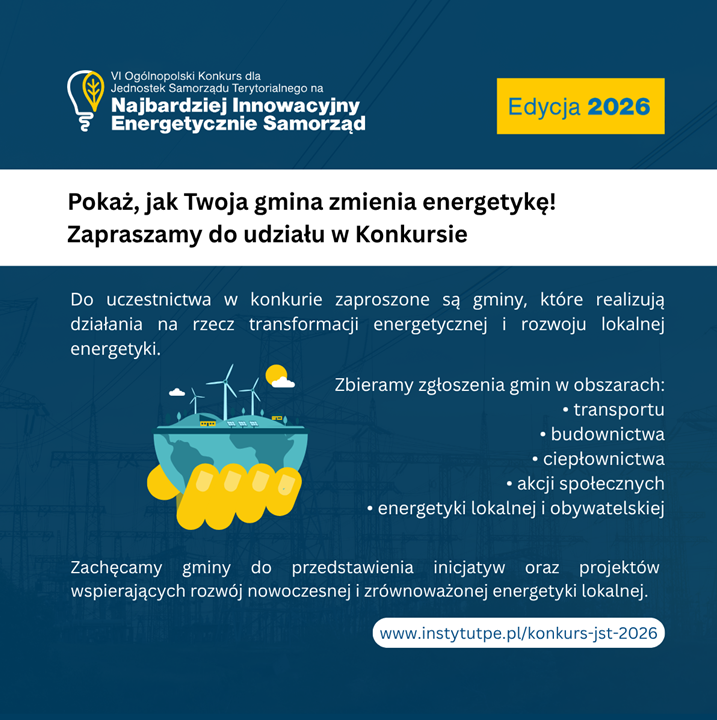
Applications are now being accepted for the 6th National Competition for Local Government Units for the Most Energy-Innovative Local Government – 2026 Edition
The Ignacy Łukasiewicz Institute of Energy Policy has announced the 6th edition of the National Competition for Local Government Units for the Most Energy-Innovative Local Government. The aim is to recognize municipalities that implement measures for energy transition in a systematic, innovative, and sustainable manner and strengthen local energy security.
Competition Objectives
The competition is open to municipalities and—starting with this edition—entities affiliated with municipal governments. The goal of the competition is to showcase the best examples of both investments and community initiatives. The competition organizers interpret the concept of innovation very broadly. This includes product, process, organizational, environmental, marketing, and social innovations, as well as innovations in the field of public policy.
As every year, participation in the competition is free of charge. A jury composed of experts will evaluate projects, initiatives, and tasks completed in 2025. The jury’s composition can be viewed here: https://www.instytutpe.pl/konkurs-jst-2026/kapitula-konkursu/
For the second time, the National Association of Local Government Organizations is serving as the honorary patron of the competition.
For local governments, participation in the competition is an opportunity to showcase their achievements, receive an impartial evaluation by experts, and gain exposure on a national and industry-specific level (through the competition’s media partners and among participants at the Rzeszów energy conference).
Competition Categories
Entries will be evaluated in the following categories:
Construction Project of the Year
Transportation Project of the Year
District Heating Project of the Year
Community Initiative of the Year
Innovation of the Year – Local and Community Energy
The last of these categories (Innovation – Local and Community Energy) is a new addition introduced this year. It includes, for example, energy cooperatives, energy communities, energy clusters, and distributed energy models involving municipalities.
A well-organized energy community is an important tool for local governments committed to the energy transition. It is worth promoting such examples and rewarding the best ones. The Łukasiewicz Institute of Energy Policy has experience in the fields of local and community-based energy, primarily through its collaboration with municipalities in establishing energy cooperatives.
In this year’s edition, for the first time, municipalities may submit projects carried out by municipal companies and other entities affiliated with local governments.
The call for entries will remain open until September 11, 2026. The official award ceremony will take place during the 11th Conference “Energy Security – Pillars and Development Prospects” in Rzeszów on September 28, 2026. The conference itself is the largest gathering of the energy sector in the region and one of the most significant in the country. In recent years, energy issues from a local government perspective have taken on increasing prominence at the event.
Patrons
The honorary patrons include:
Zygmunt Frankiewicz, Chair of the Senate’s Committee on Local Government and State Administration
The Presidium of the Sejm’s Committee on Energy, Climate, and State Assets (ESK)
The National Alliance of Local Government Organizations
Renata Janik, Marshal of the Świętokrzyskie Voivodeship
Olgierd Geblewicz, Marshal of the West Pomeranian Voivodeship
Paweł Gancarz, Marshal of the Lower Silesian Voivodeship
Władysław Ortyl, Marshal of the Subcarpathian Voivodeship
Adam Struzik, Marshal of the Mazowieckie Voivodeship
Jarosław Stawiarski, Marshal of the Lubelskie Voivodeship
The conference “Energy Security—Pillars and Prospects for Development” is being held for the eleventh time. Participants include government officials, energy company executives, members of parliament, local government officials, industry experts, and researchers. In addition to panel discussions, the event features workshops, business meetings, and company presentations.